Показ дописів із міткою exposed. Показати всі дописи

середа, 31 липня 2019 р.

Bizarre Wikipedia Edit War on Quentin Tarantino's "Once Upon a time in Hollywood"


Wikipedia is many things for many people. Some view it as the go-to place to check some basic facts, others view it as a template for the future universal source of all knowledge, a sort of an imperfect start of a the great thing. There are some people who genuily try hard to make it so, and there are other people who fuel the so-called Wiki Wormhole with unexpected and downright weird things found in the far corners of the world and the web (AV Club even runs a column about that).

Finally, there are people who take an advantage of Wikipedia being a massive compendium of seemingly sourced information to intentionally distort and manipulate certain facts in order to orchestrate an instances of confusion and conflict.
The usual victims of such actions are articles on politics, political theory, public figures of all sorts and most of the science-related articles.
The editorial boards and active users try to keep things straight for the benefit of the public. But sometimes the trolls persist and this causes so-called "edit wars" in which the story of changes and attempts to find out the reason why becomes more prominent than the subject itself.

That's what happened this time.


Quentin Tarantino's new film "Once Upon a Time in Hollywood" came out into a wide release in late July. The film garnered a positive buzz and made a splash at the box office. As any significant film release - it got a page on Wikipedia. For a while it only had an official plot synopsis and the list of cast.

But around the time the press screenings rolled out and the wide release date was coming up, it was expanded into a full-blown plot description with spoilers, et al. This things happens all the time and usually it is not a big deal.

However, things weren't that simple this time.

The big thing about "Once Upon a Time in Hollywood" is that it is a historical fiction that applies a bit of artistic license over a depiction of certain historical events. In this case, it is a murder of Sharon Tate and several of her friends in 1969 by the cult leader Charles Manson and the members of his "family".

In the Tarantino's version of events, the murder never happened due to chain of events that diverted the attention of the "family" members to the film's protagonists Leonardo DiCaprio's Rick Dalton and Brad Pitt's Cliff Booth who quickly dispatched them in a gleefully gruesome fashion. And everyone lived happily ever after, because the film is a fairy tale. It is a spin on the historical event that tries to imagine what could have been if things went a little differently.

However, the Wikipedia description of the concluding section of the plot that appeared in late May after the film's Cannes premiere was drastically different from what actually happened on the screen. It retained the story point of murder plot falling apart, but it took things into much more outlandish direction.

Here's the bit in question:


The fact of that this plot description was fabricated and misleading was repeatedly pointed out by the film critics. As Andrew Woods put it: "Don’t even read it if you don’t want to know what DOESN'T happen." (great statement, by the way). 

Incorrect and downright made-up plot descriptions happen all the time, thats a part of Wikipedia's crowdsourced nature, especially for the anticipated media releases. The difference from this situation is that upon release the information gets corrected and everybody move on with their lives. 

But this time, when users tried correct the plot description, they hit the wall. Why? The thing is - Wikipedia guidelines have a line that says "it is not acceptable to delete information from an article because you think it spoils the plot". 

And so - each time users edited the bit - the fake one turned up again. It happened multiple times going into the release week. The film's "talk" page shows a fascinating story of what was going down behind the scenes. 

The initial discussions were about casting controversies, how much of the film's plot the summary should reveal and whether the editors should respect Tarantino's wishes to avoid spoilers. 

Then things took a turn sideways and started to get weird. It all started when one of the editors claimed that he saw the film at the Cannes premiere and stated that the plot description on Wikipedia was false. However, the other editors started to argue whether Cannes viewers can be considered as a verifiable sources of information. As one of the editors put it "You have once again have not explained how I, as an editor, am able to verify the plot summary". 

Despite that, multiple users requested to fix the section and the things kept rolling back to the made-up bit again and again up. It was a loop. And it went on up until the film's wide release in UK and North America in late July that put a definitive end to the debate and reinstated the real conclusion of the story to the plot description.

To be honest, this particular edit war is a great narrative in of itself. It shows the struggles of sourcing and depicting information on the web and it points out how shaky things are when the sources can't be verified and the public involvement goes out of control. 

But it overshadow the thing that started it all - falsified conclusion of the story in the plot description section. 

***
The made-up ending is interesting thing from the conceptual standpoint.

In essense, this kind of retelling is taking an artistic license on a plot point that itself took an artistic license on an actual story. And as such, it is a showcase of derivative creativity - another spin on an idea, a variation on a variation. It functions in the same context but drives the story in a different direction using the same moving parts of the plot.

If anything, this kind of spinning and slightly making things up is how people do things since the beginning of time. We do it all the time as a kids to impress others just to look cool. The made-up ending is something like that.

Deriving from the existing and experienced things is how the cognition amps up the imagination. After a while things get complicated, the line of sources and the bleedthrough of various elements mix-up more and more to the point the derivative piece becomes a thing of its own with its own distinct themes and identity.

"Once Upon a Time in Hollywood" wikipedia made-up ending is a testament to the dedication of the Tarantino's fanbase. Whether it was mean-spirited or not is beyond the debate. The fact is - it was misleading and it caused something of a fuss. 

But it shows the level of investment into the work of art similar to pro wrestling "fantasy booking". And we all should do it from time to time, just not make that much noise about it.


пʼятниця, 9 листопада 2018 р.

MFT: Celebrating MindVox ASCII Banner

Of all the things you can find on the internet - bizarre promotional typographic constructions are among the ones that also always manage to occupy a special place in my heart even though there is nothing special about them even if you lower your standards of specialness low enough for them to qualify.  

The reason for that is simple - they are easy to play with through various text manipulation and transformation applications. That's the thing with ASCII stuff - it is fun to mess with. 

Case in point - MindVox ASCII Banner. The startup was founded in late 1991 by two former members of Legion of Doom hacker group - Bruce Fancher AKA Dead Lord and Patrick Kroupa AKA Lord Digital. It was an Internet Service Provider of a new kind - the one free of corporate shenanigans (something that is becoming increasingly timely right now when the notion that corporations and their grip on the internet is detrimental to the very essence of the world wide web became obvious even to the most casual users). By the mid-90's the service was shut down, probably because it was way ahead of its time and there was not enough momentum to sustain it on a proper level.

Nevertheless, their legacy lives on. And they left a fancy banner for me to screw with. While it is not really a piece of sophisticated artistry, there is a weird charm to this logo, the way the characters are arranged and formatted. 

Takes a look:


         /\_-\
        <((_))>
         \- \/
 /\_-\(:::::::::)/\_-\
<((_))  MindVox  ((_))>
 \- \/(:::::::::)\- \/
         /\_-\
        <((_))>
         \- \/

There are slashes left and right, underscores, dashes, dashes, dashes, colons, colons, colons, brackers, less-than sign, more-than sign and the name of the company "MindVox" right in the middle of all this. Also - the whole thing is manually centered to compose an image. There are whole lotta spaces involved in this unthankful operation. 

While you play with those things long enough (and you do because it is rather time consuming exercise in wasting time) - after a while (a long-long while) you can get some really unexpected things out of it. You can even get some sweet conceptual poetry out of it, if you waste your time hard enough. But it is fun to mess with it just for the sake of it. 


понеділок, 22 жовтня 2018 р.

BSPH: Ernest Hemingway - Blank Verse


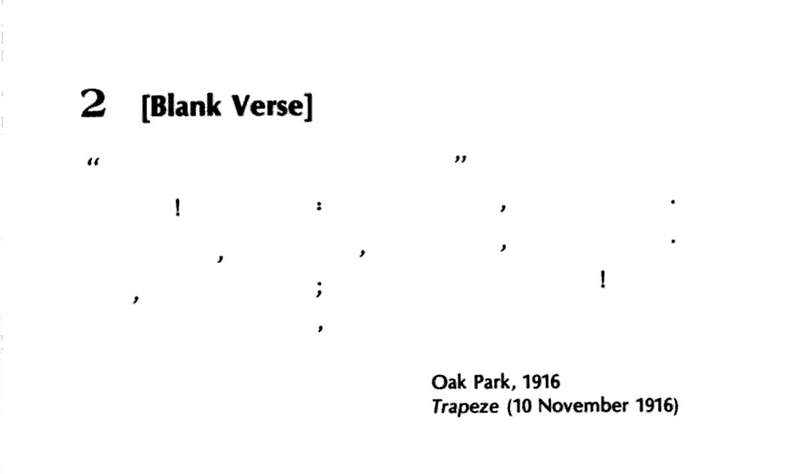
This is “Blank Verse”. It was written in 1916 by Ernest Hemingway. It started out as a school assignment but went far beyond the original intent. The piece was published later in November of that year in a humor column Air Line of a school newspaper Trapeze.
As you can see — it is a five line poem that consists only of punctuation marks divided by a certain amount of spaces to resemble some sort of a text object.

To be exact — there is a pair of quotation marks with a wide white space inside; an exclamation mark, colon, comma, dot; comma, comma, comma, dot; comma, semicolon, exclamation mark; comma. All peppered with a deliberate amount of whitespace.

It was Hemingway’s VERY literal interpretation of the eponymous literary term. While it was definitely conceived as a joke — it is more than just a frolic trifle. Even if it goes far beyond the author’s intention.

Consider the moment in which it was written. Things were obnoxiously dire in 1916. It was the year when the world was petrified in abhorrence of the World War I bloodbath. Earlier that year a group of renegade artists and writers gathered together in Zurich to declare their complete and unmitigated desperate disdain to over-sanitized, bowdlerized mess that Western Culture had turned into. Accidentally, Hemingway channeled this disdain for the old ways in his jest of a poem. Simply because he didn't gave a damn about the possible implications of his piece. He just wrote it.
Because that’s how you make cool stuff.

***

“Blank Verse” is a poem that haves fun. It is an attempt to avoid the usual pattern of thought regarding poetry. It is a dare of sorts. The poem denies the opportunity to be read, perceived and interpreted in any conceivable way.

Instead, the reader needs to acknowledge the impossibility of perceiving the poem the usual way and let it go as it is. Because it is a joke.

There is also a fruitless alternative — to try to fill in the blanks or think about the missing pieces in a given context. In a way, the poem can represent the starting point of the creative act, a plan of sorts.
But this is a mere assumption. This is not what the poem is about. As it is — “Blank Verse” is a shell of a text, a plan, a score. It can both ways — be anything and nothing in particular.

The composition gives some sort of a faux guidance. Vast white spaces in-between the punctuation marks suggest that there is a space for the text. It was left out and it can be added. The punctuation itself provides with clues of what could have been or could be.

The punctuation marks are the narrative of a poem. There are, at least, five potential sentences. Quotation marks obviously give away the title or the quote. Or it can be something described as a catalyst of a poem. Then there is something exclaimed. Possibly the nexus point of the poem. The next sentence digs into the concept. There is a possibility that it is turned around 180 degrees, then another 360 and then another 180. Afterward, there’s some sort of a aggravation with intense imagery. Recounting of features or dense, rasp of actions is also possible. At last, there’s a sentence cut in the midst of the action, possibly by means of dynamics. It is left ambiguously unfinished. And then another exclamation mark that concludes the narrative.

The last mark — coma is a sole symbol in the line and it just hangs there — as a biting reminder of the sheer impossibility of full comprehension.

***

Aesthetically — “Blank Verse” is a concrete poem, the one where visual, typographic elements prevail and dominate over the textual.

Its blankness is the point. It emphasizes the ubiquity of poetry as a concept and at the same time mocks its dubious pretense. You don’t need words to compose a poem. After all — it’s all about the composition.

And since the words tend to be interpreted in a variety of ways (sometimes way too many for the benefit and the detriment of the text) with a decent possibility of being misunderstood in varying degrees of severity — why not just leave them out of a poem? And instead — use something that can be definitely understood only as it is.

The thing is — you can’t interpret punctuation any other way than it is. Any way you look at it — it is there to perform its function and nothing more. It may be confusing in a certain context, it may be misused, but it is never something else.

And the thoroughgoing audacity of it performs an elaborately vicious extermination of a rational thought which brings this odd and misplaced notion of transcendence.

***

“Blank Verse” is what it is. It is a fascinating poem that doesn’t even need such basic elements as words to work. Its presence is imposing enough to make an impression. In the same time, it is still a throwaway joke. Just the one that goes way beyond its original intent without even trying — by mere accident.

And if you think about it, for what it is — “Blank Verse” is very effective at doing its job. It is aware of what it is and yet there is an indelible mystique to it. It is unknowable.

It is the poem that humbles the reader. It is what it is and nothing else. One can’t beat it, can’t crack it, can’t put it in a certain perspective, can’t impose own meaning to it, can’t claim any interpretation as something worthwhile or relevant to it. All the reader can do about it is to admit defeat, swallow the pride and take the poem for what it as it is.

In the same time, it is a poem that is so devoid of clues required for any sort of interpretation — it leaves a lot of space for it to thrive unanchored. It gives an additional dimension to the poem. In a way, it also needs nothing but overthinking. “Blank Verse” strives for the ironic interpretation — for all sorts of imaginary making-of, changes of context, transformations and overzealous analysis. It can bend any way imaginable and yet retain its mystique and even magnify and multiply it.
If anything — this is what real poetry is all about.

середа, 3 жовтня 2018 р.

Accidental poetry of a game review


This is an unusual review of the newest videogame about Marvel Comics franchise player character Spiderman. It was released a couple of month on Sony Playstation 4. The review video was made by Mr. Sunday Movies and it is not your standard game review. On one hand, it is not what it is supposed to be, but on the other hand - it is more than one would expect.

Unlike any other Spiderman game reviews that flooded Youtube around the time the game was released - this one stands apart as being a thing of its own while retaining a semblance of a routine assessment commentary with a tongue firmly and tenaciously in cheek.

Part of the reason it is so lies in the very simple fact - this review blatantly omits every single trope of the traditional video game review. There are no background to speak of (except for the statement that the review copy was provided by the publisher), no technical context of the review is presented, there is no personal perspective in any manner, there are no comments regarding controls, no comments regarding the narrative structure or the pacing of the game. In a way, it gives little to no information about the game that might be helpful in the consideration process. And despite all this - it succeeds in making a lasting of what the game is about.

Instead of relying on info readalong and truism spattering - this review just lists bunch of stuff you can do in the game. There is a reason for that - an author admits he never really did a game review and has no idea how to put it together and make it stand apart from the rest. And so he does just the opposite. He makes a game review and makes distinct by not making it.

And since the game is made in the genre of a sandbox - this is probably the best way to show an audience what the game is about on a practical level.

The text of the video is something to behold. It is an unintentional piece of poetry. The that happened on accident despite lack of effort. Sometimes it happens that way, especially when the thing in question is clearly of throwaway nature. Since the text is built on the list structure - there is certain hypnotic, monotonous rhythm. It is what makes it work.

Here's a transcription in case if the video will ever go down:

Hello!
This is my review for Spiderman on a Playstation 4.
I have never reviewed a videograme before
So i'm going to list all the things you can do in the game.

Let's go.

You can run up the wall
You can climb in a vent
You can kick and kick
and web and punch and flip and kick
and jump and web and punch and kick
and kick and jump and jump on a web and then
WHOP!

You can be strangled
You can play a circuitbreaker minigame
You can play a different minigame (matching wavelengths)
You can run up a when
Then you can flip pver the building and it is beautiful sunset
And you are falling and you are falling
You think you need to grab a thing
and then you web and you go up in the air
and you do another flip
and then you are in free fall
and then you zip and you are on a little lamppost

You can have your Playstation 4 internal software catch a program glitch
so you are extremely limited by what you can show in your review

You can stealth
Look at me stealth
Dah - Knock on these boxes

You can stealth as Spiderman
and then injure a man beyond repair

You can stealth on a speeding vehicle
or die trying

You can run and run
and run and run
and run and run
and round and round
and run and run
and run and run
and run and run
and round and round
and run and run
and run and run
and round and round
round round...

You can swim - uh...
You can web three guys to a garbage truck and celebrate in front of them.
You can watch carrot chopping...

(awkward pause)

You can ice skate... you can't ice skate...

You can chase a pigeon
and then kill a pigeon.

And that's all the things you can do in Spiderman on Playstation 4.

середа, 28 березня 2018 р.

Anthony Burgess was hardcore

I was reading Anthony Burgess' memoirs while gathering materials on his primitive man language for "Quest for Fire" (read his 1981 account on the thing - it is pure bliss). Among other things i have found rather hilarious story about his study of James Joyce's "Finnegans Wake" titled "Joysprick".

The story goes - Burgess was working on a study of Joyce's use of language in "Finnegans Wake" when he went to Italy. One day Burgess put his precious manuscript into a fancy bag and went to do some photocopies of the manuscript. And then some petty thug on a motorcycle snatched the bag and went away. Here's how Burgess tells the story:
"I wrote a book on the language of James Joyce, I carried it in its Gucci case towards a Xeroxshop to be copied, but it was scippato on the way. The typescript was presumably fluttered into the Tiber or Tevere and the case sold for a few thousand lire...

These scippatori were never caught by the police, who probably shared in their proceeds: their little motorcycles were not legally obliged to be fitted with a targa or numberplate. Petty crime is excused, or even exalted, by the greater crimes of the Quirinale."
Usually, when such thing happens - it is a legitimate tragedy. Just think about it - you spent a lot of time working on it, put a lot of effort, you've been thinking about it in numerous dimensions, structuring, sketching, hatching, belching - and then it is gone and it will never come back. Losing your work, especially in such frustratingly random manner is crushing. It hurts real bad. But Anthony Burgess was no ordinary sensible artiste. He was breaking the pattern of surviving misery.
 
Burgess had the guts to shrug it off like it is nothing and say "So What?" in an unimpressed manner. Instead of trying to retriece a manuscript or simply go on - he rewrote the entire book from his memory. Because that is the most obvious thing you can with a language study of one of the most complex novels of the 20th century. Not only that but he also stated that the whole ordeal made the book better.

The way he put it is exceptional piece of self-criticism:
"...I had to write the book again, not with too much resentment: it was probably better the second time.
... 
"I wrote the book again at once, since my brain had already photocopied it but cerebral photocopies are apt to fade."
 
 This little story is a lesson of grit and tenacity.

понеділок, 12 березня 2018 р.

MFT: Nothing on the Internet Browser Plugin

"Nothing on the Internet" is a browser plugin designed for Safari and Chrome browsers. It was developed by Joseph Ernst and Jan van Bruggen of Sideline Collective in late 2017. It is one of the conceptual browser plugins that is trying to make an existential statement.

The plugin is all about nothingness or if being exact lack of content. It presents this concept as "the most interesting thing on the internet" which is apparently all about content (insert Daniel Bryan "No! No! No!" chant), but it never goes beyond that. And that diminishes its initial impact to a null and void. There is no punchline in this plugin. It is a gimmick plugin, a mere publicity stunt. It turns an attempt of escape from information into a button mashing jest. But an idea is curious at the very least.

The plugin is very simple. All it does is an elaborate clean-up of a viewed page. It throws out the majority of visual elements seen on the page - the text, visuals (pictures, gifs, videos), ads and so on. and leaves barebones layouts of a page - vast spaces of nil. Just click the button and wipe it all out. With extreme prejudice, apparently.

If you try it on this blog - you will get a hard case of whiteout that will make Ed Brubacker proud. However, if you try it on Google image search or 9gag or Giphy or Tumblr Archive - you will get a fine collection of colourful blocks of various rectangular shapes.

In some way, it can be interpreted as a response to ever growing overconsumption of information without rhyme or reason and continuing overexposure to a warped and twisted reality of internet that seriously affects perception of reality and multiplies confusion and frustration. It is all too much (ta-dah, da), there must be some way out of it. "Nothing on the Internet" serves as a panic button, an AdBlock pushed to extreme, that makes it all go away for a moment. But not really.

Surfing on internet is extremely time-consuming and ultimately critically counterproductive thing. It renders users numb and unfocused, incapable of any substantially beneficial activity. Instead, users are treated like pawns in a grand game of manipulating opinions and perceptions for own good, generating web traffic and turning it into revenue. All while they are watched, dissected and segmented so that they could be presented with personalized packs of advertising content in order to manufacture impressions and clicks.

That wasn't what the Internet was about. As Wyatt said "We blew it".

середа, 24 січня 2018 р.

Bil Sabab Power Hour: White Zombie - Thunder Kiss' 65


"Thunder Kiss' 65" is a song by American horror rock band White Zombie. It was released in 1992 as a lead single of their breakthrough third album "La Sexorcisto: Devil Music, Vol. 1". It is a tale of love and betrayal and despair and great umbilical struggle of this and that and that and that. It is one of those songs that grind their way to your brain viciously but seeming leaving no trace behind. You can't really catch this song and think it was just a dream - but it really happened and it is really that good.

From a musical standpoint "Thunder Kiss' 65" is slightly jumpy funk groove rock and roll song with elaborate fuzzy twang of wasteland stoner rock spliced with a little bit more bluesy meandering hard-edged rock. White Zombie specialized on trashy, bottom of the barrel sleaze with elaborate arrangements and extraordinary tenacity. This song is a nice showcase of the bands ability to make extremely simple catchy song that is seeming beyond description. It is based of one riff that jump around with its tongue sticking out. It feels like it is going backwards but apparently forward but obviously backwards and rather awkward.

The vocal melody comes clashing with the riff - it is head banging contest. And the riff bounces back like a ball time after time. Then things spiral out of control in the chorus with a complex drum pattern. It is a delight to listen. Then "damage control break" comes and things go berserk with guitar turning into sonic flame-thrower writing its own sequence of notes in the air. For a moment it seems to be tamed but than it breaks away and spits fire with sparkles in all directions. Pure bliss. Sweet nuthin'.

Lyrically - it is a caroulesamba bish bosh of horror movie cliched imagery combined with grindhouse movie vernacular. It is half-based on namedropping of various b-movies as elaborate metaphors or plot points. But there is a story hidden deep inside. It is about a girl being really bad and probably a time warp to the past (or not) and then she meets somebody and he gets blown away (or not, who cares). It's a bunch of cool sounding words, ok?

If you read the lyrics of this song separately from listening to it - you might think it is glossolalia transcribed and edited to resemble coherent text. 

Accompanying music video is a thing of its own. Aesthetically it is solid gold tribute / homage to the ultimate great Russ Meyer and his magnum opus "Faster, Pussycat! Kill! Kill!". Kinda. It is just people in the middle of nowhere (aka desert) hanging out - dancing with smash zooms and tilts. There is also a guy in a luchador mask, cape and tightsuit. He means fun.

"Thunder Kiss' 65" is flashy, smashy and absolutely nonsensical. Despite this - it is 100% effective.

неділя, 21 січня 2018 р.

Critical Beatdown: Black Dahlia Graphic Novel - the David Fincher's version


I just read a graphic novel adaptation of an adaptation of James Ellroy's "Black Dahlia" (more on that later). Long story short - 'twas bad. 

***
I'm a big fan of blood-drenched minced meat prose of James Ellroy. I've learned a lot from his ultra-condensed no-bullshit prose. The way he ties up random details into one puzzle, the way he establishes character through little touches - the man knows how to deliver more with less. 

Ellroy's primary weapon is Occam's Razor and he uses it as a butcher's knife. That is particularly inspiring - everything is chopped to fit together just barely, you can see the stitches and it is either excessively bleeding or is already drained of substance. His writing is as grotesque as the things he writes about. The texts are also quite poetic - wild mix of different slangs, argots, hard-boiled vibe and out there metaphors is worthy of Ezra Pound. 

What is puzzling to me is that almost none of these qualities are translated to film in any measure of adequacy. You know - there is only one great Ellroy adaptation - "LA Confidential" and its greatness is based upon its willingness to step away from the source to make a better film narrative. Other adaptations are so-so for the very same reason but there is also one that is actually stupendously offending in its lacklustre nature - Brian De Palma's "Black Dahlia". But i will not talk about it because i'm bad at morbid comedy. 

I'm going to talk about David Fincher's attempt at adapting Black Dahlia.

пʼятниця, 12 січня 2018 р.

MFT: Superman 64 speedrun


This is a video of a speedrun of a game "Superman 64" developed by Titus Software. It was released in 1999 on the heels of success of "Superman: The Animated Series". It is bizarre thing to watch.

Here is why.

Video games are tricky things. They are ultimate form of vanitas - you apply your skills and spend your time in order to reach to the very end of the game (100% finish is preferable) and then you feel good for a moment or so and that is it. You may learn a lesson of sorts but it is up to you. And as for vanitas - video games are extremely hard to do. Not only from a conceptual point of view - it is simply hard to pull off technically. Too many things to think-through, too many things to lay out, too many moving parts. It is gruelling and ultimately punishing to say the least. And the fact that it is multi-billion industry doesn't make it easier.

It makes it stranger. Case in point - Titus Software's "Superman 64".

This game is infamous for its bizarrely unplayable state. It wasn't made that way because of lack of skill. It wasn't intended to be a piece of infuriating, frustrating, annoying, irritating conceptual art. It happened that way because of pressure from the publishers. As you already know - it is a licensed game based on a DC Comics character Superman. Why it is so notorious? The thing with licensed content is that often license holder don't really know what kind of product they want. And that results in frustrating start-stops all of a sudden, making changes on the fly, last minute tweaks, backtracking and other extremities that slowly but surely turn the whole thing into a mess. And if combine it with the developers who plan things they are not really able to realize - you get something really special. In the worst way possible.

"Superman 64" manages to combine visual ugliness with mechanic inaneness. What kind of game it is? Japanese call it "kusoge" - "so bad it is actually quite funny".


"Superman 64" is based upon aesthetics of "Superman: The Animated Series". Its story revolves around Superman's gal Lois Lane, Superman's pal Jimmy Olsen and Professor Hamilton the Science Guy being kidnapped by evil bald definitely Pinhead Lex Luthor. As if it wasn't hard enough - he put them into virtual recreation of Metropolis. Superman came to rescue and got into the trap and so he forced to "play the game". Which is "flying through the maze of rings around the city", then walking around and punching shadow-like pew-pew figures many-many times, then flying through rings again. If you think about it - flying stages are classic Luthor messing with Superman circa early 60s. But empirically flying stages are "Battletoads" level of psychological abuse. It can seriously deteriorate your mental state in a matter of minutes. In the future it will be recognized as a form of torture. It also looks good on paper. If you think why Superman couldn't just break the game by sheer force of his powers - he was affected by kryptonite fog. In a virtual reality (it is actually an excuse for very limited drawing distance of the games engine). Along the way Superman manages to fight Metallo, Darkseid (really) and even Brainiac. And then he saves his friends and Luthor escapes because of course he does. Player get congrats and that's it.


Originally it was supposed to be an open world game where Superman what do his thing but then the suits came in and everything escalated to excrement tornado. The game fell victim of ambitions and lack of focus. Publishers and developers were never on the same page and that caused a lot of perturbations and refurbishing on the fly. That is what happened with "Superman 64". 

You can't really play it - you endure it. You can't even motivate yourself to move on from level to level. It annoys you to the point you simply abandon it. But there are some die hards who just don't give because reasons. Believe it or not - there is a man who actually had beaten this game. Even more so - he performed a speedrun of sorts on it. His nickname is headstrong1290. 

This undeniably significant even happened at Awesome Games Done Quickly event. This is probably the best way to experience this game.

понеділок, 8 січня 2018 р.

My Favorite Things: Mark Kermode's "love" of Michael Bay and "Transformers"


This glorious song of pure unexpurgated horror is performed by British film critic Mark Kermode with a little help of his friends - skiffle band Dodge Brothers. It is all about Michael Bay and his then-upcoming fourth entry in the "Transformers" franchise.

There are only a few things in life that can bring you a smile no matter what. Mark Kermode's attitude towards Michael Bay and his signature brand of film-making as represented by Transformers franchise is one of them. Mister Kermode can't stand Mister Bay. He hates his guts. He is disgusted with its obnoxious demeanor. He is appalled by the fact that such kind of film-making is in demand. And he likes to tell everyone about his disdain in great detail. His diatribes against Bay are masterclasses of verbal takedowns with extreme prejudice. Seriously - you can learn a lot how to bury something so deep into the ground it will fall into the Earth's molten core.

Just listen to this soundbite from his review of "Pain and Gain": "Werner Herzog could look at pain and gain and actually be scared". Pure bliss.


But Mark's not only all talk. He can also delightfully show how painful it is. His vignettes dedicated to certain news connected with Michael Bay and Transformers are also something to behold. In them Mark is not afraid to fool around in order to prove his point.

For example - here is his reaction video for "Revenge of The Fallen". It is something that can be described as "wordless review". First we get a clip from the film which is all death and destruction and then it segues into Kermode's reaction which in short can be described as "SMASHING HEAD AGAINST THE WALL LONG AND HARD". Metallic sounds come out clanging. Once, twice, three times, four times. He smashes his head against some metal constructions, the wall, against the magazine with a transformer on it, against handrails. Then he takes a distance and runs straight to the wall. After uneventful collision he gets up and goes away while the screen fades to while with a shimmering high-pitched drone.


The short was continued when "Dark of the Moon" was released. It starts off with Mark coming to the camera and taking his glasses on. He then proceeds to smash his head against the camera and the screen itself.

It is sad.

Or here is his reaction to the announcement that Michael Bay will direct Transformers 4. Unlike previous video which pure impressionist tone poem - this one is embedded with narrative. Mark gets up in the morningm makes himself a cup of tea, sits down at the table, open his laptop and sees the disturbing news - Michael Bay will direct another Transformers movie. The news take Mark off-guard. He is shocked. He covers his face with a palm and trembles filled with existential horror as if he just experienced some Eldritch abomination in his stomach. And then he starts smashing his head against the laptop - seemingly to the eternity since the video cuts off.

четвер, 28 грудня 2017 р.

BSPH: Mel Bochner - Blah Blah Blah


"Blah Blah Blah" is a title of the series of paintings by American conceptual artist Mel Bochner. It is text-based paintings that repeat particular ubiquitious phrase in rainbow-toned palette. And nothing else. Because "a little bit more might be a little bit too much". On a surface it is traditional conceptual swerve - inciting incident for mind domino effect that turns into wandering in the maze. But in this case it is only a diversion - the mind game goes nowhere. It is not the point of the piece. The real thing is the VOID the painting represents.

But let's take a step back. What is the meaning of "Blah blah blah" the phrase? Commonly it is a signifier of certain portion of information that can be considered as somewhat silly, pretentious, utterly boring and decidedly lacking anything of particular interest. It is used as a cut-off placeholder and substitute for words that mean little or nothing at all in a moment.

"Blah Blah Blah" the painthing is annoying in its simplicity. It is also rather brutal if you know the story. From a standpoint of conceptual art history it can be considered almost a leering wink that suspiciously lacks tongue in cheek. For Mel Bochner it is more than just a rib. It is his kind condemnation of oversaturation and overexposure of words and images to the point of complete desensitization of the recipient. There are way too many thing to perceive and because of that mind turns on its inner Juey who in his turn shuts off any distractions that may cause the thing known as "thinking" or to be exact "contemplation" or "pondering". "Becos to menny".

But it is not only media criticism. "Blah Blah Blah" is also scathing story of self-doubt of an artist. Bochner questions himself and his skills for adequacy. He shows that he can lay the thing out, choose the words, composition, colors - but that doesn't mean that the result can sum up to anything. Technically "Blah Blah Blah" is a hijacking of the word in a manner of Ed Rusha. The word is displaced and thus transformed into something else that it is similar to the original but functions differently. It is very simple and yet extremely effective way of changing perspective and going beyond for no reason at all.

"Blah Blah Blah" is a potboiler placeholder for something else that will never come. And it is something any artist is mortified with.

понеділок, 11 грудня 2017 р.

MFT: Richard Serra - Verb List (AKA verbs are the tits!)

I was thinking about verbless poetry recently. I saw Ezra Pound's "In the Station of the Metro" in the newsfeed and then i've heard thunder but there was no visible lightning strike so i was left without a proper closure. I've tried to write a poem without verbs on the fly but ended writing mostly fun-sounding verbs and nothing else. They were simply jumping out of my head. It was unconscious - i wanted to get out of comforting flow into the unknown - i wanted to do something else. And so i was hoarding incresingly bizarre verbs in a revolving coil of ludicrity. And then i thought that after such elaborate vocabulary exercising - it would be quite useful to actually try to write a poem without verbs.

And so i ended up staring at the blank sheet of paper for some time because i didn't really wanted to write a poem without verbs at that particular moment. No matter how hard i've tried to pretend to channel Ezra Pound - i just couldn't get pass through another tasty verb without taking it with me before it vanished in my head. 

I guess it is a problem no one cares about - you can't escape from using verbs. At least for prolonged periods of time. Not that it is really matters or something - it is just utterly unneccessary. I mean - it is fun to OULIPO up yours once in a while - but in the end there is even more fun to be processed by casually ignoring self-imposed constraints.

Why bother messing with the verbs? Verbs simply convey actions, occurrences and states of being. As any other words they bring something to the table - they transform the text. You can think them over, interpret, put into the picture or out of it - any way you want. And that reminded something.


Here's a list of verbs titled "Verb List Compilation: Actions to Relate to Oneself". It was written around 1967-68 by an American conceptual artist Richard Serra. It is an instruction manual disguised as an art piece. The list is comprised of verbs in infinitive form. It is a neat compilation of various verbs you can apply to yourself or anything else and turn it into empiric performance piece. 

Despite its ambiguousness - all verbs more or less relate to the actions generally applied during an artistic process - such as cutting, mixing, stretching, arranging, covering, expanding, continuing, etcetera. But they are taken out of the context and gathered together seemingly at random. All the verbs in the list describe the processes of giving or changing a form of something. The list mainly deals with such questions as "What are you doing?" and "What you can do?". The whole thing comes from an observations Richard Serra had made while working in his studio. He simply documented what he was doing step by step. He verbalized the way he was dealing with materials and the way he comprehended the very nature of artistic process. 

Originally the list was simply a handwritten note - somewhat reminescent of school dictionary expansion exercises. But later it spawned numerous derivative piece such as "Splashing" or "Scraping Hands". It shows the potency of taking out the words out of actions and transforming them back into actions. And that what makes it so powerful.

"Verb List" exceeds its primary purpose. As a list it is bigger than sum of parts it represents. It is a kaleidoscopic snapshot of an artist's mind in the mode of self-reflection. But it is distanced from the artist's point of view to the sheer abstraction. It is a selection of words designed to convey certain things stripped of its original function. In the list - the words are free from their usual roles. They are just there. It is the mind that puts them here or there depending on chosen context. In that way - the words on the list are like flies trapped on the sticky ribbon flytrap forced to embroil themselves and roll into makeshift cocoons in order to turn into moths that inevitably will be attracted to the fire of the mind (cue Coil).

The list is incredibly flexible. You can bend them any way you want and still you will be within its boundaries. It can serve as a direct instructions or just some boorish tips or you can simply enjoy the way the words sound together. You can make your own list, rearrange the existing sequence, find some obscure relations and construct some imagery or even narrative out of it, you can even scramble the way the words are written. Finally - you can put it through N+7 OULIPO routine and get entirely new set of verbs.

четвер, 7 грудня 2017 р.

MFT: Gertrude Stein - Five Words in a Line

If you ever happened to wander through the barely penetrable debris of the least helpful archive of experimental art of old known as UbuWeb - you might have taken a walk through the jungle of the conceptual writing section. There are lots of interesting things that would have been even more interesting if this whole goodness was properly presented and thoroughly commented. But that's needless nuances, who cares about it... 

Anyway - near the end of the selection there is a piece written by one and only Gertrude Stein. It is extremely short and rather obviously undermines the entire selection of the pieces by its callous tongue-in-cheek nature. Here it is:

Five Words in a line.

It is taken from a poem "Five Words in a Line" which is a little bit longer but not really because the rest of the text dances around the statement "Five Words in a Line" but not really because the rest of the text is just there, hanging around, having a good time letting you to read it. Why? Because reasons. It is self-explanatory language play that goes for an elaborate cognitive dissonance mambo ribbing akin to "The Treachery of Images". The trick is that there is no trick. It is really a sentence with five words that describe "Five Words in a Line". Because it is amusing and kinda funny. Among else - there are also "Four Words in a line" and "Six words in one line", both of which actually consist of "Five Words in a Line". (chuckles-chuckles).

"Five Words in a Line" stems from an observation. Gertrude once noticed that she can fit five words in a single line on the page of her notebook. It seemed rather fascinating to her and so she played with it. The poem was written around 1929-1930 and published later in 1930 in the first issue of Pagany magazine. It was accompanied by an essay about Stein's poetics written by William Carlos Williams. The juxtaposition is quite ironic. It actually ridicules an essay. Since the poem is rather mean-spirited mockery of overt explanations and far-reaching interpretations - to pair it with a glib example of such analysis is rather elegant way of rolling an index finger around the temple while excessively smiling and rolling eyes. Imagine yourself reading a magazine, reading that particular essay and then getting to the poem. I guess it might be a little bit too perplexing and off-putting.

As any other poem by Gertrude Stein "Five Words in a Line" is an assault at habitual relaxed reading. It is filled with word jamming. It is more of a cipher than an actual text - the experience of getting through it is actually an intended piece. There are lots and lots of look-alike or sound-alike words paired together in a semi-coherent strings. Together they forge comedically non-sequitir images and construct cutaway narrative stylized after stream of consciossness. Except it is filled with throwaway simple words and commonly used nothing-phrases stuck in cancellarists hard-edges sentence structures.  

"Five Words in a Line" is designed to nullify attempts at analysis. You can do it - but it will not affect the piece. Your understanding of it will stay the same if not even more enigmatic. It is hard to do a roundabout arabesque about it without acknowledging the fact that the whole affair is merely a vain bout of apophenic pareidolia. And since this is the whole point of the piece it seems obvious that by design it states "nothing is true, everything is permitted" in relation to the whole concept of "interpretation". Except it is not - because it is just about "Five words in a line" and other funny things that come with it.


середа, 8 листопада 2017 р.

MFT: Brian Cox Scotch Pronunciations

Do you remember that time when Orson Welles was so down and out that he was doing the commercials? Now it is part of the Welles' lore and fondly memefied in "The Critic" but it is rather sad period of life for The Great One. Among else it brought us stroke of genius remark "probably" and "frozen peas" meltdown. And there was also a long line of wine commercials in which are more famous for Welles going full-method wasted with every take. If only Dos Equis "The Most Interesting Man in the World" launch a couple of decades earlier... Anyway...


Sometimes big money suits try to do something that will not be blatant exploitation. This thing is one of such happy accidents. In this video you can see great Scottish actor Brian Cox pronouncing names of various types of scotch. So that you can order it adequately. That's the only thing he says throughout the entire 45-episode run. The series was produced by Esquire Magazine. Brian Cox looks a bit occupied in this series. He definitely gives negative amount of damn about the whole affair - just a job. You get that vibe and it breaks the whole thing. He's bored, apparently. Russell Jaffe would say he feels like Vader in WWF. I already have over hundred words here. Moving on next.

This series is a trifle nonce. It is a waste of Brian Cox' talent, there is no punchline to make it work. It is stretched out gag from "Kate and Leopold" where Hugh Jackman's character does a try-out for a commercial. No build-up, no pay-off. It is what it is - acclaimed actor pronouncing words. It means nothing. And that's why it is easy to spin.

Since i don't care about scotch - i perceive it as a piece of conceptual art. It is something as stupid simple as the very first video of HowToBasic where he just picked up an umbrella. You can't escape the feeling that there must be something. But there's nothing. There is glaring void behind it all. You can feel its presence. It is petrifying. Just a little bit. But it is nice thing to listen to on a shuffle. Especially if you are into doing something very pointless.

If you think about it - there many ways to make use of it. You can do a song out of it. Simple reciting of the titles. Kinda like Tom Lehrer's "The Elements". Or you can take the recording and mix them Steve Reich-like minimalist style - with looping, phasing, flanging mongolian cheek clap rampage. Or you can think about it just like that - it is better than thinking about your a) job b) family c) aspiring ambitions d)

Later Esquire did the same thing with Patrick Stewart pronouncing italian words (more like Patrick Stewart in-character as Captain Jean-Luc Picard pretending to be undercover as an actor who does educational videos) and it was nowhere near as great. Sir Patrick was really trying. It just wasn't right. That's not how you make dank feeng.


неділя, 5 листопада 2017 р.

Article with all-black illustrations: The story of Cut'n'Splash and Collected Black Panels


This is an article in which all illustrations are merely a black squares. Because it is a nice idea and i wanted to test it out. Sometimes it happens that way. Here's the story. I was looking for a gallery show to visit after work and stumbled upon an article which described an art-show designed to imitate the experience of the blind. The text was so-so but the illustration was top notch - just black squares. It was a nice touch in otherwise throwaway piece.

However this is just an excuse to talk about my long running project nobody cares about also known as Collected Black Panels. What is it? As it says on the tin - it is all about gathering black panels from various comic books and other sources. All sorts of black gathered together in the most pointless and excessively abstract collage possible. Why? Because nobody ever tried to do that (because it is mindbogglingly meaningless waste of time).

How this whole thing started? I'm a late-convert in terms of reading comic books. Sure, i've read Triple M (Miller, Moore, Morrison) "Required reading" list and some webcomics but it never really consumed me in a truly fan obsession. I also owned a copy of "ElfQuest" when i was a kid and it is still one of my favs. Then in May of 2015 i was reeling off incredibly convoluted and misguided attempt at moviemaking. Being crushed and devastated by the circumstances - i was unable to do anything for a while. And that's where comic books came to rescue. 


While pointlessly surfing on the web - i've came to some comic book related website where I've read an article about Batman's story arc "Knightfall". It was described as "Batman's having a very long, hard day which pushes him to the limit". This description really interested me. I've downloaded the story arc and started reading. It was incredible. Up to the point of Bane's "Break You" moment - i thought it was the best thing ever. It was all-killer, no-filler balls to the wall action. Then came Jean-Paul Valley Azrael-Batman and his ridiculous costume and things went south. But one thing really entertained me - Azbats facial expressions. For some reason i thought it was perfect avatar-picture fodder. And so i started to snap all the headshots of Azbats. Every each of them. I was going back and forth through the comic book looking for Azbats face. It was reinvirogating in so many ways.

Then i started to notice that some panels look very different and they can be extracted outside of their original context and reappropriated elsewhere. I started to gaze through comic books looking for a panel to step. I started hoarding them for no particular reason. Right around that time i came back to Grail Marcus' "Lipstick Traces" (my go-to book when feeling sad and lonely) and read about Lettrist antics. And i thought "Well, since i have nothing else to do - why don't try something completely different". That's how "Cut'n'Splash" was born. It was June 2015.

At first "Cut'n'Splash" was merely a place where i could drop my favorite panels from various comic books. But as time went by i realized that some panels connect with each other and construct some sort of abstract narrative. And so i started to arrange panels in a specific way in order to tell the story without even having an idea what it was. By July "Cut'n'Splash" transformed from just another "comic book stuff" to warped and twisted infinite collage comic strip that was telling something backwards. Since it is really hard to compose long narrative within Tumblr - i was consumed by making short vignettes. After a while i started to shift to more abstract-impressionist kind of story telling - something akin to kaleidoscope. 


Then reality took its tool and i was forced to move out to another city. Workload wasn't creativity-friendly and so "Cut'n'Splash" was left abandoned for a better half of 2016 (although i've composed a better half of "Eellogofusciouhipoppokunurious" around the same time). The only time in 2016 "Cut'n'Splash" was in the works was in-between two jobs in October. In November i've landed in another place which was much more relaxed and creativity-friendly. Slowly i started to get my groove back and by March 2017 i was ready to restart "Cut'n'Splash" with a new found drive. That's where "Collected Black Panels" comes in. 

Black panels were one of those things that instantly fascinated me. It is something of a rarity in comic books. Because purely black panel is a waste of space that can be used to tell a story. Within a story's context black panel can really improve the narrative by letting the reader imagine certain events. But usually it is just a blackout or signifier of passage of time. It takes a considerable skill to use it to maximum effect. My first big encounter with black panels was in one of the Frank Miller books. I guess it was "Daredevil: Love and War". There were two sequences of black panels. It was incredible. After a while i've found out that there are lots of abstract monochrome panels sometimes wordless, sometimes with some exclamations or comments. Some of them found its way to "Cut'n'Splash" (i've used black panels to punctuate transitions between episodes) but the majority were left unused.


In March i started to read "Love and Rockets". One of the things that impressed me about it was the way black panels were used. They were telling the stories on their own. It was something like David Mazzuchelli's adaptation of Paul Auster "City of Glass" (the best comic book ever, btw) - really abstract but endlessly fascinating. It left me puzzled. I had no idea what to do with it. I had several hundred of black panels of all sorts and i kept hoarding more and more of them. And then it struck me "I have a lot of black panels too!" and the very next thing i did was registering another blog aptly titled "Collected Black Panels". 

The concept is simple: to construct infinite abstract collage comic strip made completely out of monochrome panels. Sure it is a bit silly to use purely black panels - considerable part of the snaps contains onomatopoeia, exclamations, parts of the dialogue, some comments, etc. It all adds up to an imaginary narrative that don't even exist in the thing but in the reader's mind while perceiving it. Why bother doing that? Because while there are lots of examples of Black Paintings - no one ever tried to construct Black Panel collage and never really tried to simply collect black panels. 


At the time of writing this text "Collected Black Panels" contains over five hundred of monochrome panels of all forms and times from so many different comic books i doubt i'll ever be able to recall even some of the sources. 

середа, 18 жовтня 2017 р.

Seriously Strange: Boxzum Accidental Pixel Calligraphy

I have a soft spot for old games from my childhood. Games like - StarCraft (best game ever, no contest), Undying, Total Annihilation, Diablo, Hexen-Heretic, Crusader, Moto Racer X, Little Big Adventure, Fallout, Karmageddon... They all appeared in a right time when i was really looking for some intense experiences. I still feel the influence of those games in my own stuff - they shaped the way i perceive things and understand the inner workings of certain elements. For example, level designer from Moto Racer X really helped me to understand the importance of intuitive level design the hard way. Or Doom Total Conversion packs showed that you can use the fundamental mechanics and take them into very different direction. Back in the day - there was this outlaw Frontier feel to game design - something that is now polished and adjusted and stinks like WWE. Also - nostalgia of some sorts. That's why i'm using ClassicReload to tame my thirst for the old stuff.

Today I was trying to find Warcraft 2. Because the gameplay music makes you play harder. Love that feeling. And my search was erratic for some reason. I guess it was all because i was using a different browser with VPN - search engine results were giving me creeps.

And then i stumbled upon BOXZUM. And it was rude kind of glorious.

Boxzum is a Snake-like game for DOS. As far as i can understand - you need to fight against two other snakes. Initial sessions were complete failure or triumph of hilarity. I had no idea what the player needed to do in order to make progress. I was stumbling in first seconds of every bout. Quick search gave me zero information on the subject. But i've grown without manuals - so i wasn't running scared - i've continued to play it while being completely out of context - because that's what real gamers do (bahahahaha).

Soon i've found out that BOXZUM makes rather curious patterns. And so i decided to make more of those patterns - instead of actually trying to beat the game. Sometimes it happens that way. Because you take more than the game gives.

This resulted in a series of patterns that you can view below. Some of them are simplistic, other seem to be peculiar, there are also some that remind me of some cryptic asemic writing. Anyway - it was fun to do.

пʼятниця, 1 вересня 2017 р.

My favorite things: Rooster attacks, kills and eats Cobra

A BIT OF REALITY.

This is rather puzzling moment in my life. I'm in a place which is very unfriendly to me to say the least. I'm in the NGO which deals with Judicial reform and it doesn't really seem like they really want me to be here. Or to make difference in their field. I guess they just want to hang out on grants and i'm kinda irriting in my overzealousness to do something. And so i'm sitting here - getting treated like a fucking piece of shit who don't belong here for no reason at all. Why people are so mean? It is not fair. I'm not fucking with them, i'm not screwing their work, i'm not bullying anybody - i'm doing my job and the workload doesn't leave much space for extra activities. I'm writing this because there is nothing for me to write about at the moment. I need to write this down because i can't keep it inside of me anymore.

Basically the only thing i really can do is writing - that means my career opportunities are rather limited. I was hired to write stuff. Because i know how to write an awesome article. But there is a catch. I can't write a good article if you mess with me the hard way. I can't read anybodys thoughts and i trust my gut when it comes to writing - thats the way i am. I'm doing it for long enough to be confident in my skills. But then over and over again i get discouraged and plain shamed for my writing skills as if i was a first-year student interning. Why? I wasn't the only person to apply to position - i guess there were many others who were a better fitting for it - but i got the position and then something strange happened because the whole team is acting hostile towards me. As if i was brought in as a result of executive meddling. I keep hearing "You know nothing", "You don't get it", "This sucks, rewrite it again" -  that's rude. I may be new to the topic but i'm no stupid. And if asking something you can at least point me out where i can look it up. You don't need to remind that i don't belong here every moment.

Why the hell should be in such unpleasant place? Why the fuck should i tolerate such attitude? Down with it. Watch this video:


This is my pep talk of the day. Rooster got intimidated by the cobra. And what was his reaction? Just bite dat mofo, lay smackdown on him and then eat him because being bully is bad for life. Kinda like that.


неділя, 20 серпня 2017 р.

Russell Jaffe's Five Word Story Challenge

You all know six word stories. It is bullshit. They usually suck although they shouldn't but for some arcane reason it always happens that way - no matter how hard you try to charge the narrative and pack the punch - it is always a whimper and never a reality warp.

Its joke is in its elusive nature. It seems to be simple but it is beyond simple. It is nothing and all you get is what you make of it on your own. A literary equavalent of placebo. Down with it.

But what if we take away one word? That makes a five word story. Is any different? Not exactly but who cares? 

Russell Jaffe aka editor of TL;DR magazine had posted on his FB-account a challenge to write some five word stories because six word story format is not enough anymore anyway.

my entries:
  1. nightfall. pounding blue hand bulge. 
  2. flytrap licker hugs chalk dancing. 
  3. horseradish daisies decay. orangutang blushed. 
  4. blurt entropy - chops horrors. duck. 
  5. fix gloomy blankly. eerie wink.
  6. octopus drops blood. perfect smile.
  7. Estimate pineapple. Moan blow. Fumbling
  8. humble glimmer fright. bitter gaunt (silence). 
  9. frisky heart jerk. hatchet elevation.
  10. twisted clouds hoop. pinch. smirk.

пʼятниця, 14 липня 2017 р.

Fun Coincidental Playlist

It's not like I'm really trying hard to make up something like this. It just happens. I was in the midst of a cooking session - doing omelette and listening to Betty Davis on Youtube.
And then came turn of her song "In The Meantime" and it all flushed out in a wormhole of the songs with the same titles. I didn't even noticed it until the Helmet song started because the style shifted so drastically. Later that day i was looking for one link in the browsing history and only then i realized that i've listened to four songs with identical titles in a row. Which is stupid.

Here's how it goes:


пʼятниця, 30 червня 2017 р.

Seriously Strange: Yuushi Daigoken Dragon!!!!! posts

Once upon a time i was gathering info for something and presented various scraps to a girl i was attracted to. She reacted with repulsion and said "you've got too much free time if you're doing this - i can't afford myself to do that - this is ridiculous". It was a major turn off. We never spoke again. She later became an exotic dancer.

Nevertheless, i have too many friends who showcase same kind of attitude. And it is just stupid. I know you all have jobs to do but so do I. And yet I find time to do stuff. And you just shit your pants every time somebody else is wasting leisure big time. Hey, that gal in the glasses - i'm talking to you!

Ok. And now straight to the point.

I have no idea who Yuushi Daigoken is. As far as I know she or he or whatever is a musician, doing some electronic kinda dance-noise stuff and some visual arts too. But what sparkled my interest to her person was seemingly neverending series of posts with the word "DRAGON!!!!!!!!!!". Every day for the last month i kept seeing it. And it was rather irritating. People kept asking her why did she post such things - but there was no reply. But there was a mystery and its by me.

Personally, I don't care why she posts it. It doesn't matter. The whole thing reminds me of really monotone nothing-special works of On Kawara while the tone reminiscent of Yayoi Kusama and Yoko Ono. And because i had 15 minutes to screencap the whole thing - you can see it from the beginning to this day - June 30.

Lo and Behold! There are somewhere around 150 images.
Enjoy!


DeepSeek doesn't about Ginger Baker making tea song either

So i did it again but this time i asked DeepSeek the same question. The following text is the edited version of the conversation. I really l...